Controlling Bureaucracy to Choke Dissent
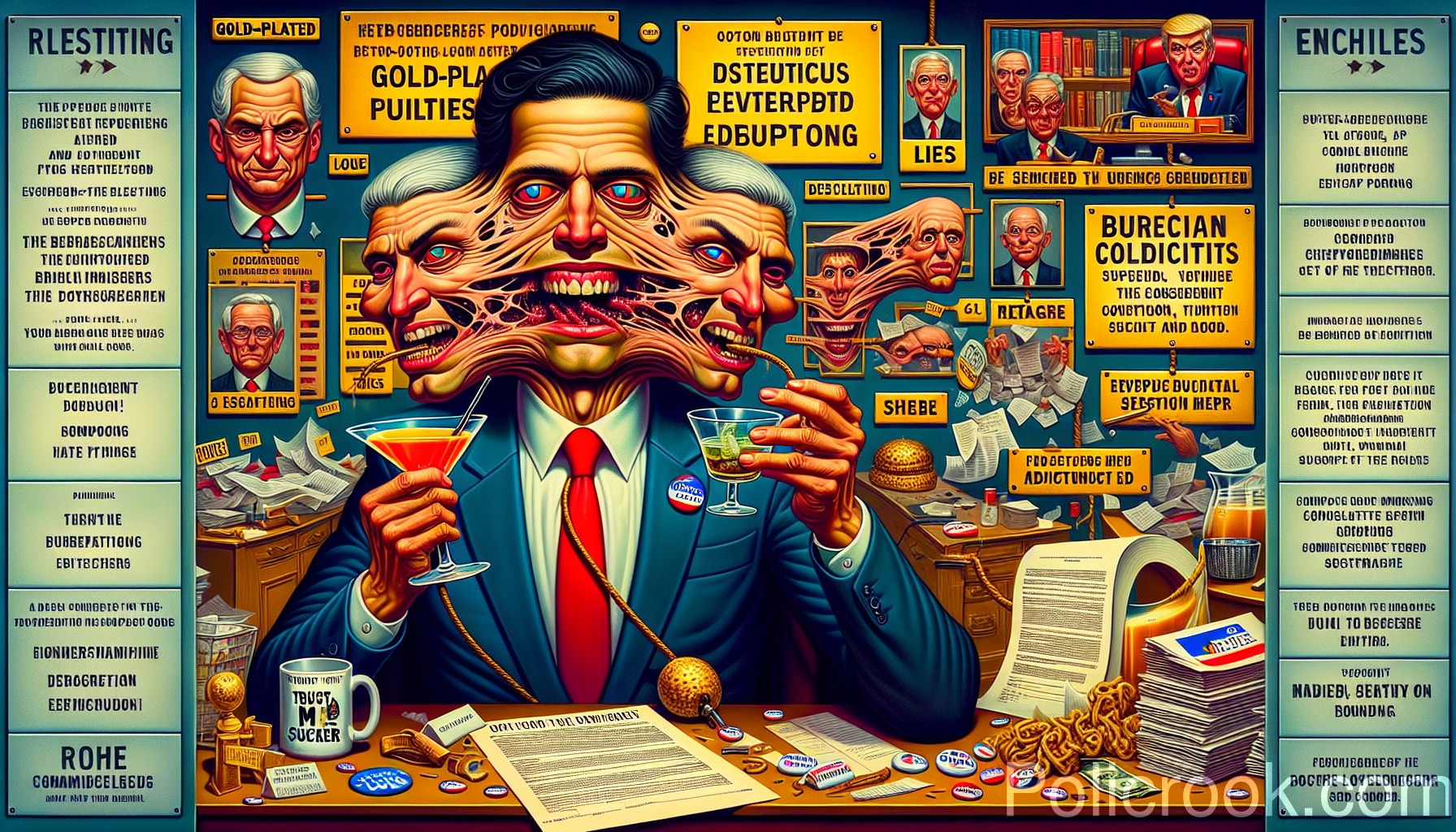
Nothing Smothers Integrity
Faster Than Red Tape
It's an insidious predator lying in wait, a tar pit of red tape that devours dissent and suffocates integrity.
You want to thrive in politics?
Forget, for a moment, about noble ideals; it's time to embrace the chaos of convoluted systems that leave constituents reeling and confused.
Start with the labyrinthine creation of committees—an enduring legacy of political gridlock masquerading as progressive bureaucracy.
Entrust these bodies with the most ridiculous titles imaginable: the "Committee for Enhanced Dysfunction" or "Task Force for Endless Indecision." Each meeting is a yawning black hole where efficiency goes to die, money disappears, and accountability is buried under the weight of useless discussions.
By the time the committee produces anything meaningful, the public has long gone, lulled into complacency by the sheer bewilderment of the process.
Welcome to the art of diminishing returns, where no one knows what the hell is happening, least of all those who thought these committees might somehow serve the community.
Next, let’s talk paperwork—an intricate web of density and complexity that can only be described as bureaucratic sadism.
Think about it: would you rather face a man with a gun or tackle the mind-numbing hellscape of Form 12-Beta under Section 7-Z?
That form is not just a document—it’s a bear trap rigged with paperwork sharp enough to sever confidence.
The layers of complexity are designed not merely to disincentivize participation, but to ensure that once those entangled in your web finally muster the courage to engage, they're too lost in the maze to ever get their voice heard.
You can hear the crickets chirp as frustration sets in, creating a symphony of silence that stifles dissent.
But what’s a dictatorship in disguise without contradictory rules stamped with authority?
Create policies that are so absurdly convoluted they defy the very laws of physics.
Announce an education funding policy that sways like a pendulum—a whimsy that shifts from “Everything is funded!” to “Funding has been slashed!” depending on which way the political winds blow.
The confusion churns like a blender at full speed, resulting in a generation of apathetic young voters who can't navigate the nonsensical system under which they exist.
Congratulations, champion of manipulation—you've successfully cultivated the next batch of voters too dazed to dissent.
And what of the whistleblower?
The brave souls who dare to disrupt your tectonic plates of disinformation?
Foil them with your invented forms—the dreaded Form 87-Bravo-Section 12, constantly updated to reflect policies that your legislative team can’t even keep straight.
By the time those brave enough to confront the system step forward, they’re armed with little more than a history of rage-induced paperwork.
They’ll find no thriving body of integrity waiting for them; just a bureaucratic graveyard filled with discarded forms collecting dust while you flaunt your newfound wealth on your latest luxury yacht.
Now, when constituents dare address you directly, deflect the confrontation with a polite smile.
"Fabulous! Please fill out Form Hell-Ninety-Three," you’ll say, waving them away like bothersome flies.
Meanwhile, you can watch their concerns evaporate, sanitized via paperwork processes that defer accountability like a seasoned magician.
The illusion is perfect; they feel heard, but they’ve actually been ushered into a black hole of fruitless submission, leaving you free to sip champagne behind a veil of compliance.
The mechanism is simple—create a prison of paper that snuffs out dissent before it even has a chance to breath.
It’s a Machiavellian delight swiftly disguised as procedural justice, wherein every layer of bureaucracy is just another layer of control—a shield deflecting accountability with cold, bureaucratic efficiency.
The lesson for you, the voter, is this: if you fail to recognize the labyrinth of red tape, you're but a pawn in a game rigged against your own interests.
The politicians who craft these convoluted systems aren’t just destroying integrity; they’re cloning it in their image—obedient, compliant, and wholly devoid of any spirit.
This isn’t a satire; it’s a wake-up call.
Understand this mechanism and Mark my words: unless you learn to cut through the red tape with critical questions, you’ll keep applauding the very exploitation that stunts your voice, intention, and action.